

Form follows function — and in G-spot toy design, the gap between realistic appearance and genuine performance has never been wider.
The sex tech industry spent decades chasing visual realism: lifelike textures, anatomical coloring, and surface detail that mimicked human skin. What that approach missed was a more fundamental question — does the shape actually work? Research published in the Journal of Sexual Medicine tells a clear story: circumference is a statistically significant predictor of toy popularity (p = .01), while realistic surface features like veins show no meaningful correlation with satisfaction. In other words, how a device fits and presses matters far more than how it looks. This is where ergonomics enters the conversation. Ergonomics, broadly defined, is the science of designing tools around human anatomy rather than forcing anatomy to adapt to tools. Applied to intimate wellness, it means accounting for the angle of the vaginal canal, the precise location of sensitive internal structures, and the amount of pressure required to stimulate them consistently. An ergonomic vibrator is not simply a vibrator that looks comfortable — it is one engineered to the millimeter to meet the body where it is.
Realistic features, paradoxically, can actively hinder that goal. A uniformly cylindrical or straight shaft requires significant wrist contortion to maintain the upward pressure needed for internal stimulation. Aesthetic surface detail adds friction without adding functional benefit. The engineering logic, then, points toward a different design language entirely: the curved, or “come-hither,” form. Named after the beckoning finger motion used in manual G-spot stimulation, this curve functions as a mechanical lever — converting linear motion and vibration into focused, sustained pressure against the anterior vaginal wall.
That shift from decorative to functional design reflects a broader, factory-led rethinking of what intimate wellness devices are actually built to accomplish — and it starts with understanding the body’s own geometry.

Mapping the Curve: Navigating the 45-Degree Anatomical Tilt
A curved G-spot toy isn’t a stylistic choice — it’s a direct answer to how the human body is actually built inside.
The vaginal canal doesn’t run straight. It angles upward at roughly 45 to 90 degrees relative to the spine when a person is lying down, according to Le Wand Massager. That tilt is not incidental. It reflects the natural orientation of the pelvic floor, the position of the cervix, and the path any internal device must travel to reach its target. When a product ignores this geometry, the body pays the price — usually through awkward wrist angles, reduced control, and pressure applied in entirely the wrong direction.
Straight devices create an immediate mechanical conflict. To push a straight shaft toward the anterior (front) wall of the vaginal canal — where the G-spot sits — the wrist must compensate by bending upward at an uncomfortable angle. Sustaining that position for any length of time causes fatigue, reduces precision, and pulls attention away from sensation. In practice, what starts as intentional stimulation becomes a physical endurance challenge.
The G-spot itself is located approximately 1 to 3 inches inside the vaginal canal along the anterior wall. Research published on PubMed confirms this region corresponds to an area of heightened nerve sensitivity in many people, though its exact anatomy varies between individuals. What doesn’t vary is the geometry required to reach it consistently — upward, angled pressure along that front wall, sustained firmly enough to engage the underlying tissue.
An upward curve solves all of this in one design decision. When the shaft bends toward the anterior wall, the device naturally aligns with the canal’s tilt. The user holds the handle in a neutral, relaxed position, and the tip arrives at the correct location without forced compensation. That steady, firm contact — rather than intermittent or glancing pressure — is what produces reliable stimulation.
This anatomical logic is precisely what drives the manufacturing decisions behind effective internal products. How those curves get built with repeatable precision, however, is a story that begins on the factory floor.
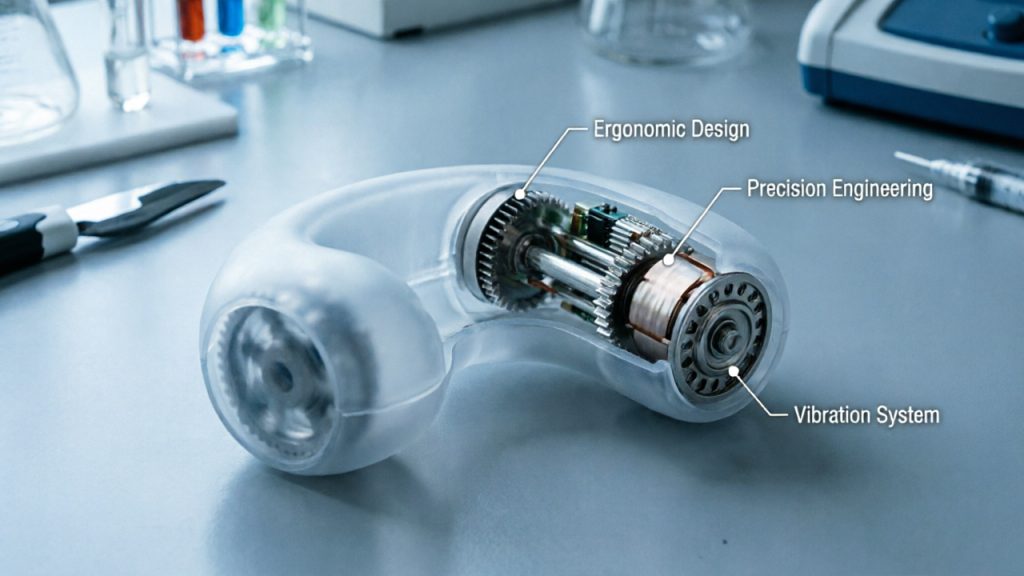
The Factory Floor: How Liquid Injection Molding Creates Precision
Understanding why ergonomic G-spot toys perform better than realistic ones isn’t just about design philosophy — it’s about what modern manufacturing actually makes possible.
Liquid Injection Molding (LIM) is the gold standard in factory sex toy design, enabling complex internal geometries that would be impossible to achieve with traditional casting methods. Where conventional molding pours material into a mold and waits for it to cure, LIM injects liquid silicone under controlled pressure, filling every contour of the mold with exceptional accuracy. This distinction matters enormously when the target shape includes precision curves, tapered tips, and internal chambers — exactly the features that separate high-performance ergonomic tools from simpler alternatives.
One of LIM’s most significant advantages is its ability to create internal nooks and hollow cavities within a finished piece. These recessed spaces aren’t decorative — they’re precisely positioned to house vibration motors at calculated depths and angles. By placing a motor inside a sealed cavity near the curved tip, engineers can direct vibrational energy toward a concentrated focal point rather than dispersing it through the entire body of the toy. The result is a stronger, more targeted sensation exactly where anatomical geometry demands it.
Repeatability is the other critical benefit. Because LIM operates under controlled injection pressure and temperature, every unit produced from a given mold matches its predecessor within tight tolerances. The 45-degree curve discussed earlier only delivers its intended effect when it’s consistent — a shape that varies by even a few millimeters between units can shift stimulation away from the intended target entirely. Precision manufacturing isn’t a premium feature; it’s a functional requirement.
This manufacturing precision naturally raises a question: how do the toys that best exploit these production capabilities actually differ from standard vibrators in their final form? That’s where the emerging category of purpose-built spot vibrators becomes worth examining closely.
The ‘Spot Vibrator’ Revolution: Targeting Internal Hotspots
Spot vibrators represent a fundamental engineering departure from standard wands — built around precision, not power alone.
A standard wand delivers broad, diffuse stimulation. A spot vibrator, by contrast, concentrates that energy into a single, intentional contact point. That distinction is the entire premise of ergonomic sex toy design explained through function: every curve, angle, and grip contour exists to place stimulation exactly where anatomy demands it.
As Le Wand Massager notes, “the magic lies in their ergonomic design… a curved or angled tip to apply targeted pressure,” making reaching internal hot spots significantly easier. That angled tip isn’t decorative. It’s a calculated response to the 45-degree forward tilt of the anterior vaginal wall, engineered so the user doesn’t have to contort their wrist to maintain contact with the G-spot during movement.
Ergonomic handles extend this logic outward. Different body types, mobility ranges, and preferred positions demand different grip styles. A well-engineered spot vibrator accounts for this by tapering the handle for a fingertip grip, or widening it for a full-palm hold — reducing fatigue and keeping stimulation consistent without constant readjustment.
The features that define a true spot vibrator include:
- A precision-angled tip that mirrors the body’s internal geometry rather than working against it
- A contoured, non-slip handle designed to accommodate multiple grip styles across different positions
- Targeted motor placement that concentrates vibration at the tip rather than dispersing it through the shaft
The dual-action “Rose” style design takes this evolution further still — pairing internal G-spot stimulation with external clitoral suction in a single ergonomic form. It’s not two products fused together; it’s one unified shape designed so both functions reinforce each other without compromise. That kind of integration depends entirely on material behavior and construction quality — which is where the real engineering story begins.

From Blueprint to Bedroom: Why Material Choice Matters
The gap between a well-engineered G-spot toy and a forgettable one often comes down to what it’s made of — not just how it’s shaped.
Medical-grade silicone is the foundation of effective anatomical stimulation technology. Unlike cheaper alternatives, it’s non-porous, and body-safe. As The Rabbit Company notes, ergonomic G-spot toy design requires a ‘come-hither’ curve to maintain firm, steady pressure against the anterior vaginal wall — and that curve only works if the material holds its geometry during use. Material density plays a surprisingly significant role in how vibration travels through a toy. Denser silicone dampens motor vibrations before they reach the surface, producing a muted, rumbly sensation. Lower-density silicone transmits higher-frequency vibration more efficiently, creating the targeted, pin-point sensation that spot vibrators are specifically engineered to deliver. Getting this balance right isn’t incidental — it’s a deliberate formulation decision made at the mold stage.
The integration of heating elements adds another layer of engineering complexity. Warming features must be embedded within the mold structure itself, close enough to the surface to raise temperature perceptibly, and but insulated enough to avoid uneven heat distribution or safety risks. This requires precision in the layering process — the kind that liquid injection molding, discussed in earlier sections, makes possible.
Bold callout: Material safety isn’t a feature — it’s the baseline. Everything else is built on top of it.
iDollri approaches this by pairing certified body-safe silicone with integrated thermal and vibration systems, keeping high-tech performance from compromising the materials that matter most. That technical discipline extends beyond what’s inside the toy — it shapes how the toy feels in the hand, which is exactly where the conversation turns next.
Solving the User Friction: Ergonomics as Accessibility
Ergonomic design isn’t just about comfort — it’s what separates a toy people actually use consistently from one that ends up in a drawer.
Handle geometry is the single most overlooked factor in pleasure product engineering. When a toy’s handle requires sustained wrist flexion to maintain the correct angle, fatigue sets in fast — and that physical strain pulls attention away from sensation. According to The Rabbit Company, an intentional upward curve acts like a lever, allowing the head of the toy to press firmly against the anterior wall without requiring the user to contort their wrist. That one structural decision translates directly into longer, more comfortable sessions.
Remote-control integration takes the ergonomic argument even further. When vibration patterns and intensity can be cycled through a wireless remote or a smartphone app, the hand gripping the toy doesn’t need to twist, reach, or reposition. The device does exactly what it should do — hold position while controls live elsewhere. In practice, this feature matters most during dual-action use, where managing both internal, and external stimulation simultaneously already taxes coordination. That coordination challenge is where the ‘how to use’ gap becomes a real accessibility issue. Dual-action devices are technically sophisticated, but their instructions rarely account for body positioning, angle adjustment, or the time it takes to learn a device’s fit. As the science behind good design demonstrates across disciplines, the best-engineered tools reduce the learning curve through form itself — not just instruction manuals.
Ergonomics, at its core, is a bridge: it converts hardware capability into something the human body can actually access without effort, strain, or frustration. As engineering sophistication grows — and it is growing rapidly — the next frontier involves mechanical movement built directly into the device’s frame, raising entirely new questions about what a pleasure product can do.
The Future of Sex Tech: Telescopic and Mechanical Innovation
Mechanical innovation is quietly rewriting what G-spot toys can do — moving far beyond static curves into synchronized, multi-axis motion that targets anatomy with engineering precision.
Telescopic rotation combines two distinct mechanical actions into one frame: a thrusting shaft that extends and retracts along its axis while simultaneously rotating. The engineering challenge is non-trivial. Each motion requires its own motor or cam system, and those components must be housed without adding bulk that compromises the ergonomic curve. In practice, this means miniaturized drive trains packed into silicone-sheathed bodies — an integration problem that took years of factory iteration to solve at scale.
Mechanical flapping takes a different approach to clitoral stimulation. Rather than vibration — which relies on rapid oscillation — flapping mechanisms use a hinged or pivoting arm that moves in a rhythmic, wave-like pattern. This produces a broader, more pressure-based sensation that some users find more reliably stimulating than buzz alone. From an engineering standpoint, the flapping arm must be calibrated for stroke length and frequency, then sealed inside a waterproof housing without dampening the motion transfer.
Innovation Callout: iDollri has positioned itself at the intersection of these mechanical advances, specializing in flapping, thrusting, and telescopic rotation features built into ergonomically curved frames — delivered at price points that make this technology broadly accessible rather than niche.
Integrating these features into a curved ergonomic body is where the real design skill shows. Every motor placement shifts the toy’s center of gravity, and that shift affects how the curve performs during use. Factory-level precision — including the Liquid Injection Molding processes covered earlier — is what keeps those motors exactly where the design specifies.
The result is a category of toys where the curve is no longer doing the work alone. It’s the foundation that makes everything else function — a point worth examining more closely as we look at what all these engineering choices add up to.
The Bottom Line: What You Need to Know About Ergonomic Design
Ergonomic curves in G-spot toys aren’t decorative choices — they are functional levers that directly determine whether a toy stimulates effectively or falls short.
Curves are engineering tools. The pronounced arc built into a well-designed toy exists to bridge the anatomical gap between the vaginal canal and the anterior wall, where G-spot tissue clusters. Without that deliberate curvature, even a premium product is working against the body’s geometry rather than with it.
The mechanism that makes precision possible at the manufacturing level is Liquid Injection Molding. This process allows motors and vibration nodes to be seated within millimeters of their intended targets, encased in a seamless silicone body. The result isn’t just about durability — it ensures that stimulation energy doesn’t dissipate through excess material or off-center placement. When the motor sits precisely where it needs to, every vibration cycle counts.
Ergonomics also functions as accessibility. Awkward grip angles, stiff materials, and difficult insertion paths create physical strain that interrupts use — particularly for users with limited wrist mobility or chronic pain. A body-mapped handle, optimized circumference, and flexible shaft reduce that friction entirely. Research published in the Journal of Sexual Research found that among 265 examined products, circumference and fit ranked more highly with users than anatomical realism — a clear signal that functional geometry outweighs surface mimicry.
The single most consequential design variable, however, is the 45-degree anterior tilt. This angle aligns the toy’s stimulation surface with the urethral sponge at the point where it’s most responsive to pressure. Matching that tilt to individual anatomy — accounting for natural variation in canal length and angle — is what separates a product engineered for results from one engineered for the shelf.
Understanding these principles makes the process of choosing the right toy far more straightforward, which is exactly where this guide leads next.
Choosing Your Engineered Experience
The difference between a forgettable toy and a transformative one comes down to a single decision: choosing intentional engineering over generic design.
Every section of this article has traced the same thread — that anatomy-informed curves, precise angle calibration, and mechanical innovation aren’t luxury features. They are the baseline requirements for consistent, effective G-spot stimulation. Research published in systematic review on G-spot anatomy reinforces what good design already reflects: the anterior vaginal wall responds to targeted, sustained pressure, not approximation.
Generic shapes approximate. Engineered shapes deliver. When a toy is built around anatomical reality rather than visual aesthetics, it converts intention into sensation — and that distinction matters every single time it’s used.
Factory-direct innovation changes the equation further. When manufacturers control the full design-to-production pipeline, they can iterate on curve radius, shaft flexibility, and motor placement without the compromises that come from outsourced tooling or generic molds. As iDollri puts it directly: “Our latest items prioritize advanced mechanical functionality and personalized pleasure.” That philosophy isn’t marketing language — it’s a production commitment that shows up in the tactile result.
The intersection of science and pleasure is no longer theoretical. Biomechanical insight, ergonomic principles drawn from design research, and precision manufacturing have converged into a new standard for what intimate products can do. Readers who understand this don’t need to rely on trial and error — they can shop with criteria.
If you’re ready to move from guesswork to geometry, explore iDollri’s collection of ergonomic G-spot vibrators and experience what happens when engineering and pleasure are designed to work together.


